The Ultimate Beginner’s Guide on How to Build Self Discipline (Without Burning Out)
Building Self-Discipline: The Steps That Actually Work
Introduction
How many times have you told yourself that you’d do things differently tomorrow, only to find yourself doing the same things tomorrow that you did today? Maybe you wanted to be the person who woke up early to work out, or who was the person that finally got their finances in order. You probably felt pretty good about your plan to do these things when you made it, but when it was time to put your plan into action, you found your motivation was nowhere to be found.
We all need self-discipline for these types of situations. People who are self-disciplined are often thought of as people with strong will-power, but that’s not exactly correct. People who are self-disciplined typically have a system, expect realistic outcomes from themselves, and have an environment which supports their self-discipline.
Self-discipline doesn’t mean being productive every single second of the day. It also doesn’t mean you can’t be productive or self-disciplined only at certain times. True self-discipline is being able to do what you’ve decided is important to you, even when you don’t feel like it. Fortunately, self-discipline is something that can be developed, but in order to do that, you first need to understand what it is and what causes you to become low self-discipline.
What Is Self-Discipline?
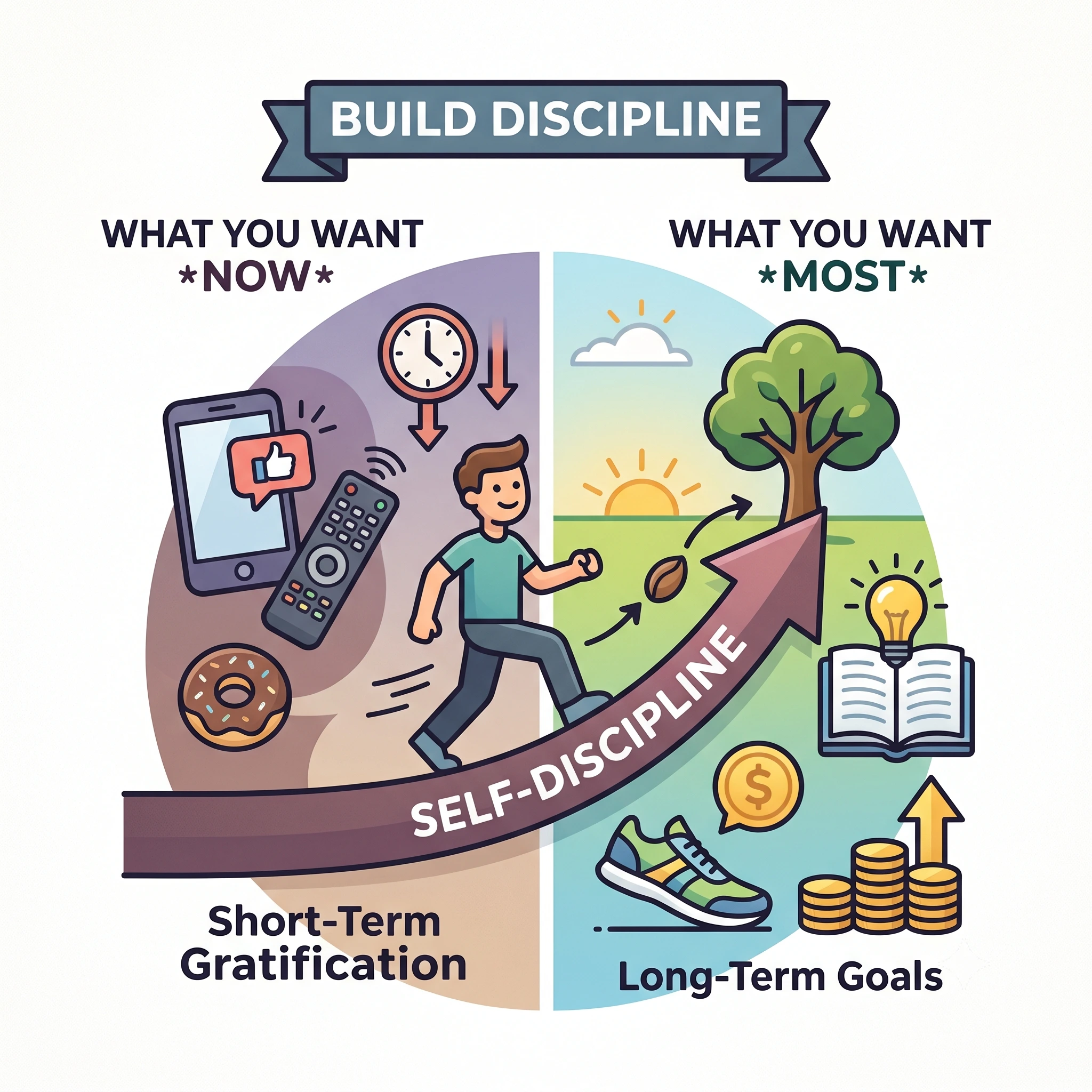
Self-discipline is the ability to do what you know you need to do, even when you don’t want to do it. It is the difference between knowing your goals and actually achieving them.
Let’s say you begin a new habit of going for walks in the morning. You feel a sense of accomplishment the first couple days. Around the one week mark, it’s raining, you’re tired, and your bed is very appealing. Discipline helps you circumvent some of these obstacles. You might tell yourself to only go on a short walk, instead of skipping the habit entirely.
Ignoring legitimate reasons to change your plans is not what discipline is about. You can be disciplined enough to know that you need to rest when you are really sick or exhausted. Discipline is not the same thing as blindly following a plan.
You can think about what you want to do in the moment and what you really want to do in the long term. In the moment you may want to watch another TV episode, but you really ought to work on your assignment. Discipline helps you do the long term goal when you really don’t want to.
Why Is Self-Discipline So Difficult?
One of the biggest reasons people lack self-discipline is because they rely too much on motivation. We all have days where we feel super motivated and then days where we feel absolutely unmotivated. You can’t exercise on a motivation only schedule because you won’t do it at all on the unmotivated days. It’s better to create a schedule where you decide when you’re going to exercise. That way you don’t have to think about it every morning.
Setting Overly Ambitious Goals
Somebody who has not exercised in half a year are not going to realistically commit to exercising for two hours a day. Somebody who does not read is not going to realistically commit to reading an entire book over the weekend. People can get excited about setting very ambitious goals but these goals can lead to a lot of frustration and an overall discouraged attitude about the goal setting process. It is better to start with a goal that you can realistically commit to and gradually increase the goal standard.
Decision Fatigue
Decision fatigue is the psychological state of being largely administered making small decisions throughout the day. A person can become tired and unmotivated to make the decisions necessary to pursue a goal. If a person wants to work out and has their workout clothes and everything ready to go, they are less likely to decide not to work out because they have to make fewer decisions.
The All-or-Nothing Mentality
You can easily fall prey to the all or nothing mentality. If you want to exercise five days a week and you end up exercising only three days that week you can easily decide to tell yourself that you will have to wait until next week to exercise at all. You need to be able to exercise discipline on an everyday basis in order to truly be disciplined.
Self-discipline is not easy but it is something that can be improved and something that you should not view as a test of your willpower.
10 Practical Steps to Build Self-Discipline
1. Start Really Small
Want to read regularly? Start with a goal of 5 pages. Want to exercise? Start with a goal of 10 minutes. The idea here is not to keep your goal really small. The idea is to make starting so easy that there is less opportunity for resistance.
An example of this would be if your goal was to exercise every day and you started with the goal of taking a walk around the block. Once that becomes habit, you can increase the time of your walks. A small action that is repeated daily is better than an action that is very large but only done a few days a week.
2. Make the Right Choice the Easy Choice
Your goals can either be supported by your environment or work against your goals. If you want to study but your phone is next to your laptop, you’ll probably end up studying…or you might not study at all.
Your goals can be supported by your environment. You can do this by placing your shoes by the door so you are more likely to take them with you when you leave or by placing your book by your bed so you are more likely to read it before you go to sleep.
3. Decide the When and the Where
“I’ll do it later” is something we tell ourselves all the time and usually end up breaking. “I’ll study math at 7 PM at my desk” is a lot harder to talk yourself out of.
If you decide on a specific time and specific place, you won’t have to continuously decide on when and where you will do your action.
4. Use the Two-Minute Starting Rule
Starting is usually the most difficult part of a task, but once you get past the initial barrier, the task becomes easier. Breaking an overwhelming task into smaller components, where the requirement for each component is just two minutes, can help get past the initial barrier.
Two minutes of writing that first sentence or two minutes of reading that first page can get you past the initial barrier for a task that feels daunting. This is a technique to gain momentum, not to bind yourself to a two-minute restriction for every task you do.
5. Create If-Then Plans
Create a plan in advance for how you will respond to the obstacles you expect to face.
Examples of these plans could be “If I want to check social media while studying, I’ll finish the current section first.” or “If I miss my morning workout, I’ll walk after dinner.”
Making a plan to respond to an expected obstacle when you are not faced with the obstacle gives you time to think about the situation more clearly and helps you avoid having to come up with a plan to respond to the obstacle at that moment.
6. Track Your Actions
Tracking your progress for a habit can be as simple as using a calendar to mark the days you complete the habit. After a few weeks of tracking, you will be able to see patterns and figure out which times of the day you are better at completing the habit.
Tracking your progress should not be used as a form of punishment, so if you do not complete a habit for the day, you should still mark that you did not complete it.
7. Connect the Habit to a Meaningful Reason
Rather than just saying “I want to save money,” determine what you want to save money for. Maybe you want to save for an emergency fund so you don’t panic when an unexpected bill comes.
Rather than just saying “I need to exercise,” think about what you want to be able to do in the future that requires you to be in better physical shape.
Having a purpose or a goal gives your actions a reason, which helps your actions be competitive against distractions.
8. Know How to Bounce Back
Breaking your routine is inevitable, and it’s important to be able to get back on track as quickly as possible. One broken study session doesn’t mean you have to miss two.
View mistakes as interruptions and come back as quickly as possible to minimize the effect it has.
9. Guard Your Energy
You can’t be disciplined if you have no energy. Constantly being exhausted or skipping meals isn’t a lack of character, it means you’re pushing yourself too hard.
Adjust your schedule to fit your real life. If mornings are chaotic, do the tasks that require concentration in the evening. If you’re drained after work, do the tasks you don’t enjoy in the morning.
10. Increase Challenges Slowly
You’re not competing against anyone but yourself. Once a goal feels easy to achieve, you can increase it.
A 10 minute walk can become a 20 minute walk, and a 15 minute study session can become 30 minutes. The goal is to have a routine that can be easily integrated into your everyday life.
Expert Tips for Self-Discipline
Set a Minimum Standard for Important Habits
Give yourself a minimum standard for important habits. A normal workout can be 45 minutes, but a minimum would be a 10 minute walk. A normal writing goal can be 1,000 words, but a minimum can be 100 words.
The minimum standard ensures you continue to do the habit when it’s difficult to do the normal standard.
Plan During Your High-Energy Hours
If you tend to think clearly in the morning, try doing your most demanding work of the day during that time, as opposed to spending that time scrolling through social media.
If you don’t function just as well in the morning, but instead have more energy later on, don’t just default to doing your important tasks during the morning hours, as advice often suggests.
Recognize Your Personal Failure Pattern
If you find yourself repeatedly breaking the same promise, look for what is actually causing that failure.
If you always end up going home to feel too tired to work out after a day of work, or if you always end up going over your shopping budget after a day of hunger, then look for those triggers and try to change your system to avoid those failures.
Make Your Goals Specific
If your goal is to be more productive, that’s great, but that’s a broad statement that is hard to justify.
If your goal is to work on your report during the school day and not procrastinate by going on social media, that is a good, specific goal.
Leave Space for Real Life
If your schedule is only designed to work with a perfectly functioning system, it will fail. Discipline means being able to adapt to new circumstances while still working towards your goals.
Common Self-Discipline Mistakes to Avoid
Treating Mistakes Like Failures
One slip up doesn’t mean all your effort was for nothing. Come back as soon as you can.
Constantly Changing Productivity Systems
Procrastination can take a lot of different forms, and so can your productivity systems.
Neglecting Rest
Discipline and routine do not thrive without recovery.
Comparing Your Progress to Others
Other people’s schedules do not align with your responsibilities. You need to compare your progress to your past self.
The Pros and Cons of Developing Self-Discipline
Pros of Self-Discipline
More trust in yourself, better time management, and the ability to make consistent long term progress. You will also become less reliant on unpredictable motivation.
Cons of Self-Discipline
There will be new discomforts as you integrate the new behaviors. There is also the risk of rigidity as you structure your routine too much.
This will take a long time, and you will have to be patient. There will also be an increased risk of self criticism as discipline and rigor merge with perfectionism.
For readers interested in building better personal routines and developing practical everyday habits, this resource can also be explored alongside the ideas discussed in this guide.
Frequently Asked Questions
How Long Does Building Self-Discipline Take?
There are no definite time restraints. Simple habits become second nature quickly, and more difficult routines take longer. It is more important that you return to the habit after being interrupted than that you hit a specific number of days.
Can Self-Discipline Be Learned?
It definitely can. You do not have to be naturally organized or highly motivated. It is the product of small commitments, an aiding environment, and follow through, like most behaviors.
What’s the Difference Between Motivation and Discipline?
Motivation is the desire to do something, and it changes. Discipline is the ability to act even if you don’t have the desire to do something. It provides you with structure to continue even when your mood changes.
Why Do I Lose Discipline at Night?
At the end of the day, you make a lot of decisions and are responsible for a lot. This can be draining and makes you want to mindlessly entertain yourself.
You can help this by planning tasks early and setting a consistent routine for the end of the day.
How Do I Rebuild Discipline After Falling Out of a Routine?
This time, don’t try to be too extreme. The goal shouldn’t be to immediately incorporate a 3 hour long daily routine.
Start small and repeat the same action for a few days. After that, you can increase the action’s difficulty and length.
Does Discipline Mean Having a Strict Schedule?
No, having a flexible plan can also have discipline. What’s important is that you have your priorities and you plan and make time for them.
A flexible plan can survive a disruption, but a rigid plan can’t.
What’s the Easiest Habit to Start With?
You should start with a habit that has a clear trigger and is low-effort. Examples are tidying your workspace for 5 minutes, or reading a couple pages before bed.
The habit should be easy so that you’re actually able to incorporate it into your daily routine.
Can I Build Self-Discipline Working From Home?
Yes, you can. You just need to set more boundaries.
You can start by setting a consistent start time and preparing your workspace. You can also decide what your top priority is for each day and silence unnecessary notifications.
You can create a short routine at the end of the day to help you reset and begin personal activities.
Should I Use a Habit Tracking App?
You can use a notebook, calendar, or a simple list to track your habits instead. You can always choose to make your system more complex, but only to the extent that it helps you track your habits.
What Should I Do When I Don’t See Results?
You need to focus on what you can control. Sometimes goals can take a long time to achieve and showing progress along the way can help you stay motivated.
You can track your progress by doing the activity and measuring the outcome instead of waiting to achieve the goal.
Conclusion
Learning to build self-discipline isn’t about achieving the most or getting rid of all the distractions. It’s about being more reliable when it comes to the things that are important to you.
You can start by focusing on one small behavior to replace instead of trying to make drastic changes to your lifestyle. Once you decide when you’ll do the new behavior, you can prepare your environment to help you and plan for distractions.
It’s better to quickly get back on track when you lapse instead of waiting for the perfect moment to start again.
Discipline is built through the culmination of many small decisions. It won’t happen overnight, and it won’t happen with one big push. You can build a new habit by making a small decision each day that virtually eliminates the choice to back out on tomorrow’s commitment.
The cumulative effect of those small decisions will help you build the discipline to bring about larger changes in your life.